If you are building your own cutlery brand — for a retail chain, a hotel group, a supermarket programme or an online store — the shortest path is to buy from a factory and put your own name on it. That is what “OEM” and “ODM” mean in practice.
The short answer:
OEM means the factory produces an existing product with your logo and packaging applied. ODM means the factory develops a product to your requirements, or offers a design it owns that you can brand exclusively. Most cutlery orders sit somewhere between the two — a catalogue shape with a custom handle colour, engraving and box.
This guide walks through what can actually be customised, what to prepare before you contact a factory, and how the order process runs from enquiry to shipment.
OEM, ODM and Private Label — What Is the Difference?
The three terms get used loosely, so it is worth being precise before you brief a supplier.
| Model | Who designs it | What you get | Typical use |
|---|---|---|---|
| OEM | You, or an existing catalogue item | A standard product carrying your logo and packaging | Fastest route to a branded range |
| ODM | The factory (off-the-shelf design) | An existing factory design you brand, sometimes with exclusivity | Cheap, quick, less differentiation |
| Custom / bespoke | Jointly — from your drawing or reference | A new handle shape or construction, requiring new tooling | Strong differentiation, longer development |
For most first orders, the practical answer is to start OEM: take a proven shape, apply your logo and packaging, test the market, then invest in bespoke tooling once you know what sells.
Whichever route you take, confirm one thing in writing: whether the design is exclusive to you, or whether the factory sells the same shape to other buyers in your market. Both arrangements are commercially normal — you just need to know which one you are buying.
What Can Actually Be Customised
1. The logo
Three methods cover almost every cutlery branding need:
- Laser engraving — the most common. A fine, permanent mark cut into the handle surface. Works on both mirror and satin finishes, and on PVD-coated pieces. Best for logos with clean lines and simple text; very fine gradients do not reproduce well.
- Stamping / embossing — the logo is pressed into the metal during forming. This gives a deeper, more premium feel and is used on higher-volume programmes because the tooling is dedicated. It reads well on solid handles.
- Etching or printing on packaging — when the metal cannot take the mark, the brand lives on the box, sleeve or blister card instead. Often combined with engraving.
A practical tip: ask for the logo to be engraved on the sample before you approve it. A logo that looks clean in a PDF can lose legibility when engraved at 8mm on a curved handle.
2. The finish and colour
Beyond mirror and satin, cutlery can be finished in PVD (physical vapour deposition) colours — gold, rose gold, champagne, black, blue and multi-colour titanium effects. PVD is applied in a vacuum chamber and is far more durable than spray or electroplated coatings, which peel.
If you are selling gold cutlery, this is the specification to interrogate. Ask how the coating is applied and whether the factory tests adhesion, because this is where cheap product fails — a few dishwasher cycles and the colour lifts.
3. Shape, weight and construction
- Handle shape — from a catalogue, or developed to your drawing (new tooling required).
- Thickness — measured in millimetres at the fork and spoon shank. Thicker reads as more substantial; thinner reduces cost. This is the single biggest lever on how “premium” a set feels in the hand.
- Solid vs hollow handle — solid handles are heavier and feel more expensive; hollow handles are lighter and more economical, and are common in budget and mid-market sets.
4. Packaging
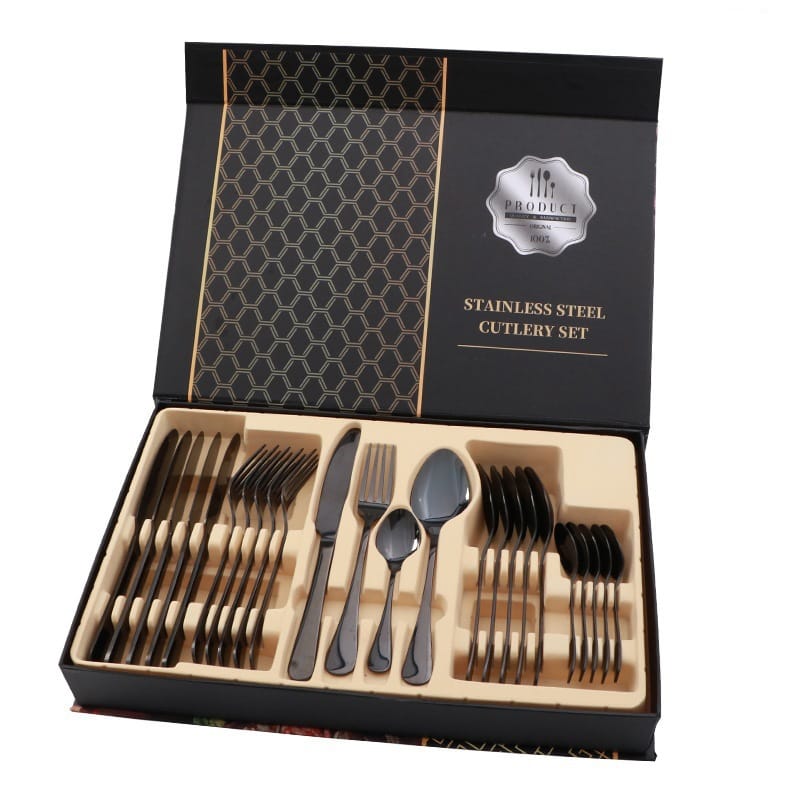
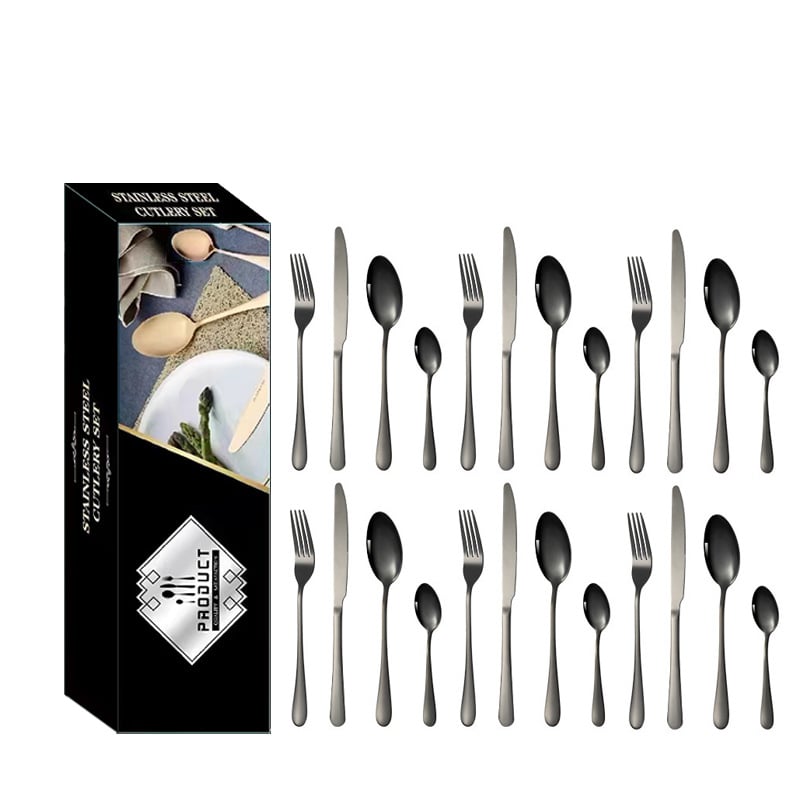
- Printed colour boxes, gift boxes, wooden boxes and display stands
- Blister packs for retail pegboard
- Barcodes, warning text and retail copy printed to your artwork
- Multi-language packaging if you sell in more than one market
What to Prepare Before You Contact a Factory
Suppliers can move much faster when you arrive with these five things. Assembling them takes an hour and saves weeks:
- A reference product or photo — even a competitor’s photo is enough to start. “Like this, but with a slimmer handle” is a perfectly good brief.
- Your logo artwork — ideally a vector file (AI, EPS or SVG). A high-resolution PNG works for engraving proofs.
- Your target market and channel — supermarket, hotel supply, gift retail and e-commerce have different optimal specifications. Tell the factory where the product will be sold.
- A rough quantity range — not a commitment, but enough for the factory to advise on tooling and packaging economics.
- Your packaging concept — even a rough sketch. If packaging is an afterthought, it becomes the bottleneck at the end of the project.
The Order Process, Step by Step
| Stage | What happens | Who leads |
|---|---|---|
| 1. Enquiry | You send reference, target spec and quantity range | You |
| 2. Specification & quotation | Factory proposes materials, finish, construction and packaging | Factory |
| 3. Sampling | A physical sample is produced with your logo and finish | Factory |
| 4. Sample approval | You check weight, balance, engraving depth and packaging | You |
| 5. Production | Bulk manufacturing to the approved sample | Factory |
| 6. Pre-shipment inspection | Finish, tine alignment, plating adhesion, packing checked | Factory (your agent optional) |
| 7. Shipping | Goods packed, cartons marked, handed to freight forwarder | Both |
Two stages deserve your full attention.
Sample approval (stage 4). This is your only cheap opportunity to change anything. Once bulk production starts, a design change is expensive. Check the sample against the packaging too — make sure the box the factory proposes actually protects and presents the product.
Inspection (stage 6). Ask what will be inspected and on what sample size. A pre-shipment inspection that checks polish, tine alignment, plating adhesion and carton marking catches most problems before the container leaves.
Five Mistakes That Cost First-time Buyers Money
- Approving a sample without your logo on it. Engraving changes the appearance of the handle. Always approve a branded sample.
- Specifying only by photograph. Two sets that look identical in a photo can differ by 0.5mm of thickness — and feel completely different.
- Leaving packaging to the end. Packaging design and printing often have the longest timeline of any part of the order. Start it with the product.
- Assuming the grade is the whole story. Workmanship — polishing, tine finishing, plating quality — matters as much as the steel itself. Our guide to 18/0 vs 18/10 stainless steel flatware covers this in detail.
- Not asking about exclusivity. If you are investing in a brand, know whether the factory will sell the same shape to your competitors.
FAQ
Can I order custom logo cutlery without a large quantity? Yes — logo engraving does not require new tooling, so branded orders can start smaller than fully bespoke designs. Bespoke handle shapes, by contrast, need dedicated moulds and therefore make sense at higher volumes.
How long does a custom sample take? It depends on the finish and whether new tooling is involved — a catalogue shape with engraving is far quicker than a new mould. Ask the factory for the timeline in writing before you commit.
Can I mix my logo on the product and a different brand on the packaging? Yes. This is common when a distributor sells to several retail chains — each chain gets its own box, while the product carries the master brand.
Do I own the mould if I pay for it? This is negotiable and worth agreeing in writing before you pay. Many factories will confirm that a customer-funded mould is only used for that customer’s orders.
Can you copy a competitor’s design exactly? We will produce a design that matches the specification you need — shape, weight, finish, construction — but we will not reproduce another company’s trademark or registered design. Send us the reference and we will propose the closest legitimate version.
The Bottom Line
Custom logo cutlery is not complicated, but it rewards preparation. Decide the market and channel first, arrive with artwork and a packaging concept, approve a branded sample properly, and inspect before shipment.
Looking for a factory to produce your own branded cutlery? Send us a photo on WhatsApp of the product you have in mind and we will reply with the closest match, or browse our product catalogue to see what can be branded.