Buying cutlery for a hotel, restaurant chain or catering operation is a different job from buying it for a retail shelf. Retail buyers optimise for appearance and price point. Hospitality buyers have to optimise for something less visible: how the cutlery behaves after three hundred trips through a commercial dishwasher.
Here is what actually matters when you are specifying cutlery in bulk for commercial use.
Three Situations, Three Different Briefs
Most hospitality cutlery orders fall into one of three patterns, and they call for different specifications.
| Situation | What it needs | What to watch |
|---|---|---|
| Opening / project order | A complete, consistent table service across all outlets | Buy the full range at once — mixing later is the main source of mismatch |
| Replacement and loss | Small repeat orders of the pieces that disappear | Keep the original specification on file, and confirm the factory can reproduce it |
| Expansion or rebrand | New pieces matching existing stock, or a new design across sites | Ask for a sample against your existing piece before ordering |
A hotel replacing lost teaspoons and a hotel opening a new restaurant are both “bulk cutlery buyers”, but they need completely different conversations with a supplier. Knowing which one you are saves a lot of back-and-forth.
The Specifications That Actually Matter
Thickness (gauge) — the biggest single factor
This is measured in millimetres on the fork shank and spoon bowl. It determines weight, balance and how long the piece holds its shape under commercial use.
Thin, lightweight flatware bends at the neck, twists at the bowl, and feels cheap in a guest’s hand — which is a brand problem, not just a durability problem. For hotel and restaurant service, thickness is the specification worth paying for. If you take one thing from this article, take this: specify the thickness, and hold the sample before you approve.
Balance
A good piece of flatware balances at the point where your hand naturally grips it. This is a design and construction question — a heavy handle with a light bowl feels wrong, regardless of how thick the metal is. Always handle a sample rather than judging from photographs.
Dishwasher exposure
Commercial dishwashers run hotter and with stronger detergents than domestic machines. Two consequences:
- Nickel content matters. Austenitic grades with higher nickel resist pitting and graying far better under repeated washing. Our 18/0 vs 18/10 guide explains the trade-off.
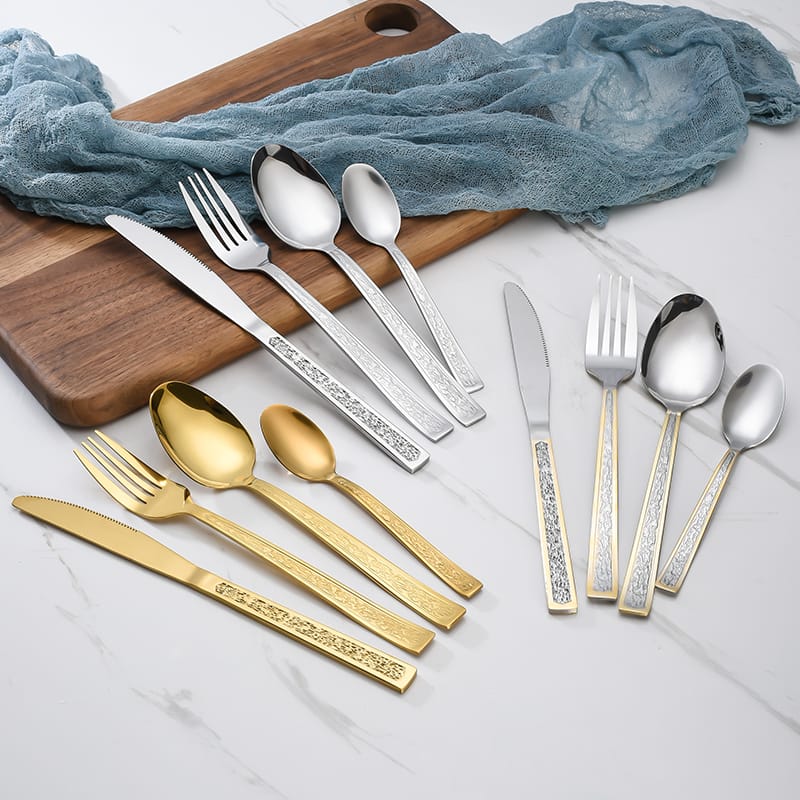
- Coated pieces need care. Gold and coloured PVD finishes are durable when properly applied and tested, but you should confirm adhesion testing with the factory before committing a whole outlet to a coated range.
Handle construction: solid vs hollow
| Solid handle | Hollow handle | |
|---|---|---|
| Weight in hand | Heavier, more premium | Lighter |
| Unit cost | Higher | Lower |
| Best for | Fine dining, hotel restaurants, retail premium | High-volume cafeterias, budget contracts |
There is no wrong answer — only a mismatch. Hollow-handle cutlery in a fine-dining room reads as cheap; solid heavy cutlery in a 600-cover canteen is money spent on a specification nobody notices.
Tine shape and edge finishing
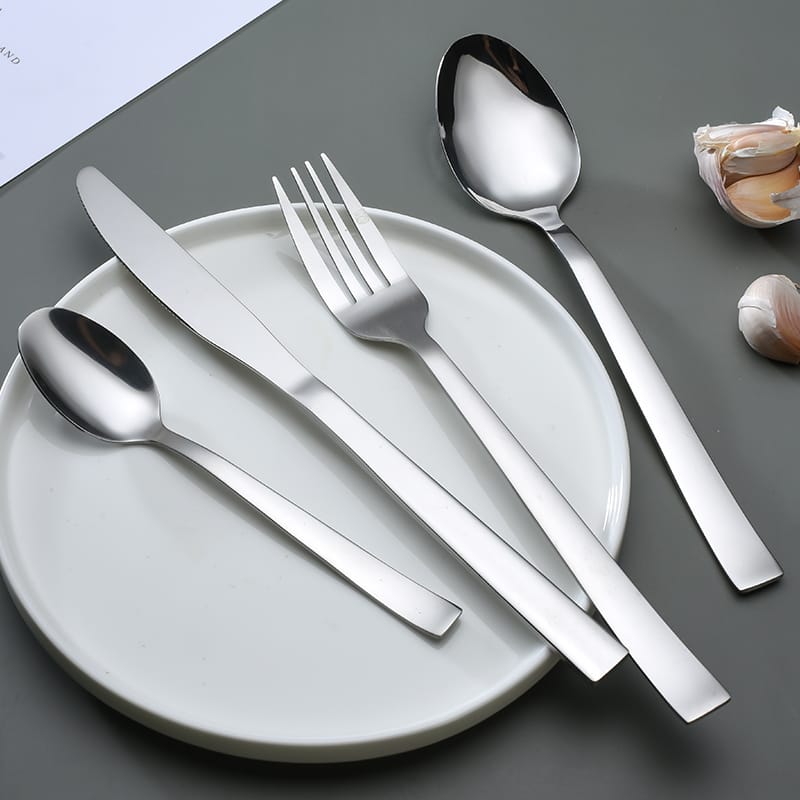
Tines should be rounded, evenly aligned and free of burrs. Sharp or misaligned tines are a safety and complaint issue, not a cosmetic one — and they are exactly what a pre-shipment inspection should catch. Ask your supplier how they check tine alignment.
Do Not Forget the Serving Pieces
A frequent mistake is specifying place settings only, then discovering the serving pieces do not match. A full table service usually includes:
| Category | Pieces |
|---|---|
| Place setting | Table fork, table knife, dessert spoon, dessert fork, teaspoon |
| Serving | Serving spoon, slotted serving spoon, serving fork, cake server |
| Beverage | Teaspoon (the highest-loss item in any operation) |
| Speciality | Steak knives, fish knives and forks, butter knives, soup spoons |
Teaspoons and soup spoons are the pieces you will reorder most often. Whatever specification you choose, make sure the factory can supply those individual items in small repeat quantities — some suppliers only sell full sets.
Keeping Replacements Matching
This is the hidden risk in bulk cutlery purchasing: five years from now, will you be able to buy a matching spoon?
Three practical protections:
- Record the specification. Not “stainless steel spoon” — the shape name or number, thickness, finish, and the factory’s reference.
- Buy a small buffer of high-loss items. A modest over-order of teaspoons and soup spoons at the original production run is far cheaper than paying for a new line later.
- Confirm continuity. Ask the supplier whether the shape is a catalogue item they expect to keep producing, or a bespoke item. If it is bespoke, ask about their policy on repeat orders and mould storage.
For hotel groups rolling out across sites, there is a fourth protection: order the whole rollout from one supplier, in one specification, rather than letting each property source locally.
Branding for Hotels and Restaurants
Engraved flatware is one of the cheapest ways to signal quality in a restaurant. A logo or monogram laser-engraved on the handle:
- discourages guests from taking pieces home (a real and measurable loss reduction),
- reinforces the brand at the table, and
- allows you to identify your stock when pieces are mixed between outlets.
Engraving requires no new tooling, so it can be added to orders at modest volume. If you also want branded packaging for gift sets or retail sales, see our custom logo cutlery guide.
Five Mistakes Hospitality Buyers Make
- Buying on price per piece alone. Replacing a cheap set twice costs more than buying a durable set once — and the replacement may no longer match.
- Judging from photographs. Handle a sample. Weight and balance do not photograph.
- Forgetting serving pieces. They are usually ordered late, in a rush, and from whoever can deliver — which is how a mismatched table gets created.
- Not specifying thickness. “Stainless steel spoon” is not a specification. Give a millimetre figure.
- Splitting a rollout between suppliers. Two factories produce two subtly different pieces, and guests notice at the table.
FAQ
How many pieces should a restaurant order per seat? Plan for more covers than you have seats — cutlery is lost, broken and removed from service faster than most operators expect. Multiplying your seat count by a replacement buffer is more realistic than ordering one piece per seat.
Can I match cutlery we bought years ago? Usually yes, if the shape is still in production. Send the factory a photo and the original documentation if you have it. If the exact mould is gone, a close alternative is often available — order a sample first so you can compare in your own light.
Is thicker cutlery always better? Not automatically. Thicker means heavier, more durable and more expensive. Match the specification to the setting: fine dining justifies it, a high-volume cafeteria may not need it. What you should never accept is cutlery so thin that it bends in normal use.
Do you supply individual replacement pieces, not just full sets? Yes — tell us which items you need and we will confirm what can be supplied as individual pieces.
The Bottom Line
For commercial use, specify thickness, construction and durability before appearance — then protect yourself with a documented specification, a small buffer of high-loss pieces, and a supplier who confirms they can reproduce the line later.
Specifying cutlery for a hotel, restaurant group or catering operation? Send us your requirements on WhatsApp or browse our flatware range to find a family of designs that covers both place settings and serving pieces.