China is the world’s largest source of stainless steel cutlery, and for importers in Pakistan and West Africa, buying direct from a factory is the difference between a business that competes on price and one that competes on nothing at all.
But importing has a learning curve, and most of the cost of climbing it lands on the first order. This guide walks through the six steps that matter, in the order you will face them.
If you are importing specifically into Pakistan or into Ghana, Togo and the wider West African market, see our market pages for the specifics of those routes: Pakistan and West Africa.
Step 1 — Define the Specification for Your Market
The single most common first-order mistake is ordering “stainless steel cutlery” without a specification. Two sets can look identical in a WhatsApp photo and be completely different products in the hand.
Define at least these five things before you send an enquiry:
| What to specify | Why it matters |
|---|---|
| Product type | Cutlery set, loose flatware, spoons only, serving pieces — different buyers, different lines |
| Thickness / weight | The main driver of durability and of how “premium” the piece feels |
| Finish | Mirror, satin, gold, black, multi-colour — this decides the retail price point you can sell at |
| Construction | Solid or hollow handle; this affects weight, cost and perceived quality |
| Packaging | Polybag, colour box, gift box, blister — packaging is a cost line and a selling feature |
If you are not sure where to start, the fastest route is to send the factory a photo of a product you already sell or admire, plus a note on where you sell it. A good factory will translate that into a specification.
Where the market changes the answer: open-market and wholesale channels generally want durable, heavier-gauge product with simple packaging; gift and modern-retail channels support lighter-gauge product in a presentation box. Decide which channel you are supplying before you choose the spec.
Step 2 — Choose Between a Factory and a Trading Company
Both exist, and both will quote you. The difference shows up when something goes wrong.
| Factory | Trading company | |
|---|---|---|
| Product range | Focused — cutlery, maybe some kitchen tools | Very broad, sourced from many factories |
| Specification questions | Answered by the people making the goods | Relayed, sometimes slowly |
| Price | Usually better on comparable specs | Adds a margin |
| Mixed containers | Limited | Can consolidate several product types |
| Accountability | Owns its own production | Depends on the underlying factory |
The practical rule: buy core product categories from a factory, and use a trading company only for categories the factory does not make. A factory-direct supplier will also tell you honestly when a specification you have asked for is a bad idea — a trading company has less reason to.
How to tell the difference: ask to see the production line on a video call, ask who makes the moulds, and ask what happens if a batch fails inspection. Factories answer these directly.
Step 3 — Sample and Inspect Before You Commit to Volume
Never place a first bulk order without a physical sample in your hand.
- Order a sample first, and specifically request one produced with your logo and packaging if you are ordering branded goods.
- Check it against your specification — weigh it, bend the fork neck gently, look at the tine finishing and the polish near the handle.
- Then place the bulk order, and ask for a pre-shipment inspection before the goods are packed.
A pre-shipment inspection should cover finish quality, tine alignment, plating adhesion on coated pieces, and carton marking. If a shipment is wrong, this is where you want to find out — not at your warehouse.
Step 4 — Get the Packing and Carton Marking Right
This step is invisible until it goes wrong.
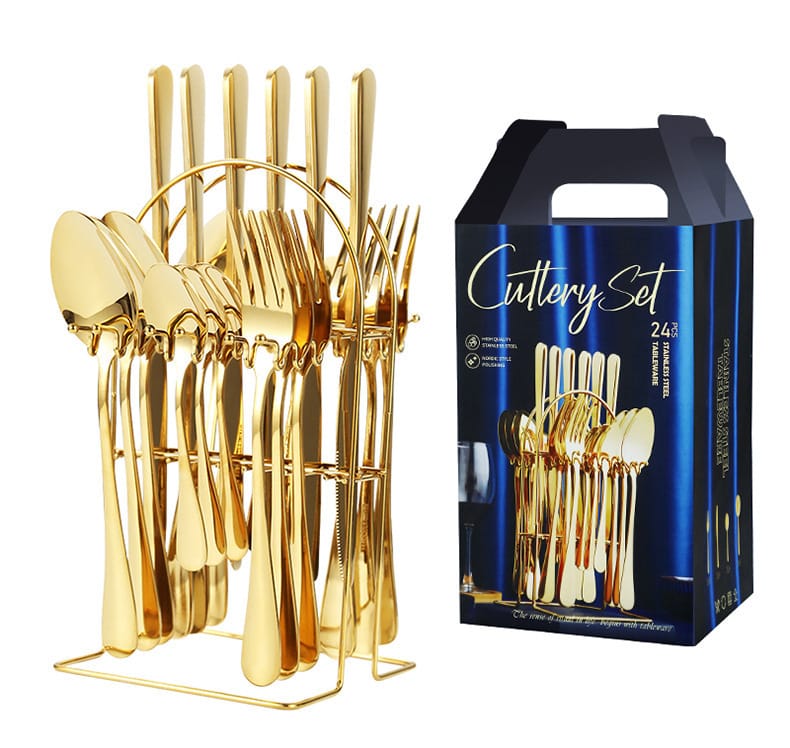
- Inner packing — how each piece or set is packed. Cheap inner packing causes scratches in transit, and scratched goods cannot be sold.
- Carton specification — cutlery is heavy. Cartons must be strong enough for stacking, and the carton weight must suit how your staff will handle them.
- Carton marking — your item codes, quantities per carton, and any import or market requirements. If your market or your customer requires specific labels, tell the factory before production, not after.
Ask the factory to send photographs of the packed cartons before dispatch. It costs nothing and catches surprises early.
Step 5 — Arrange Freight and Know Your Ports
Cutlery is dense, non-perishable and non-fragile — it is close to an ideal product to ship by sea.
Ports to know:
| Market | Main gateway ports |
|---|---|
| Pakistan | Karachi Port, Port Qasim (both serve Karachi and onward distribution to Lahore, Faisalabad, Islamabad) |
| Ghana | Tema (principal), Takoradi (western corridor) |
| Togo | Lomé (deep-water; also handles transit cargo for landlocked inland markets) |
Trade terms. FOB and CIF are the two you will use most:
- FOB — the factory delivers to the port; you control the freight. This is usually cheaper if you have a forwarder you trust.
- CIF — the factory arranges freight and insurance to your port. Simpler for a first order, and easier to compare quotes — but always compare against an FOB quote before deciding.
Consolidation. If you also import kitchenware, plasticware or other goods, ask whether your supplier can consolidate — one container instead of two cuts both freight and port charges.
Step 6 — Get the Documentation Right
Standard documents for a cutlery shipment:
- Commercial invoice — matches the goods and the declared value
- Packing list — item counts per carton, carton dimensions and weights
- Bill of Lading — issued by the shipping line; the document that releases the goods
- Certificate of origin — where your market or your buyer requires it
- Test reports — where your market or your customer requires them; ask what is needed and whether it can be arranged before ordering
Two rules: make sure the invoice, packing list and B/L agree with each other, and find out what your market requires before production starts. Documents that must be arranged after the goods are made are the most expensive kind.
Five Mistakes That Make a First Import Order Expensive
- Ordering without a written specification. Disputes over “what was agreed” are unwinnable without one.
- Skipping the sample. The sample is the cheapest part of the entire order.
- Leaving packaging to the last minute. Packaging artwork and printing often take longer than production.
- Comparing only the total price. Compare like for like — the same thickness, finish and construction. A cheaper quote is usually a thinner product.
- Not asking about repeat orders. Establish before you buy whether the supplier can reproduce the same specification in six months — this matters enormously if the line sells.
FAQ
How do I know a factory is legitimate? Ask for a live video call from the production floor, ask who owns the moulds, ask for the contact details of customers in neighbouring markets, and start with a sample order rather than a full container.
Can one supplier cover my whole cutlery range? Often, yes — a cutlery factory typically produces sets, loose flatware, serving pieces and some kitchen accessories, which is enough to fill a mixed order. Confirm the full list early so you can plan the container.
What if the goods fail inspection? That is the point of inspecting before shipment: the factory can rework or replace before the container leaves. Discuss this in advance so both sides know what happens — the answer you get also tells you a lot about the supplier.
Can you ship to Pakistan or West Africa directly? Yes. Tell us your destination city or port and your preferred trade terms, and we will quote accordingly. We can also work with your own freight forwarder. See our Pakistan and West Africa pages for more detail.
The Bottom Line
Importing cutlery successfully is mostly about the boring parts: a written specification, an approved sample, a pre-shipment inspection, correct packing, and honest documents. Get those right and the pricing takes care of itself.
Want to start with a specification and a sample? Send us a photo on WhatsApp of the cutlery you want to import, and we will reply with the closest match from our product catalogue plus a quotation for your market.